At first, getting quotes for your new kitchen cabinets feels exciting. Then the numbers start coming in…
One company quotes you several thousand dollars more than another. One has hundreds of reviews, and another has a unique cabinet style you love but no information about the company itself. And then there’s talk of lead times, warranties, construction—and suddenly you’re wishing you studied cabinetry before you requested all these quotes.
Take a breath. You don’t need to know it all to make a good decision for you.
When comparing kitchen cabinet companies, look beyond just the price of the cabinets. Compare the construction and materials, what’s included in the quote, lead times, warranty and support, and what past customers say about their experience. Looking at the same factors across two or three companies makes it much easier to see what you’re actually getting for your money.
That’s what this guide is for. We’ll cover the pieces that matter when comparing companies, so you can narrow down your options without launching a full-time cabinet research project.
What Should You Look for in a Good Cabinetry Company?
At first glance, cabinet companies can look a bit too similar. They all have beautiful kitchens on their websites, talk about high-quality materials, and have some version of a quote request form.
The differences become clearer once you look past the marketing.
A cabinet company is selling more than a box with a door on it. You’re also choosing the construction, the ordering process, the people helping you through it, and the support you receive if something doesn’t go according to plan.
When you’re comparing companies, pay attention to:
- Cabinet construction: What are the boxes, doors, drawers, and hardware made from?
- Style and configuration: Can the company provide the sizes, finishes, door styles, and storage features your kitchen needs?
- Price: What exactly is included in the quoted price?
- Design support: Will someone help you work through your layout and cabinet selections?
- Lead time: How long should you expect to wait for your cabinets?
- Warranty: What happens if something arrives damaged or a component needs replacing?
- Customer support: Can you get a knowledgeable person to answer your questions?
Look for the company that offers the most of what you need.
If you haven’t quite decided what kind of supplier fits your project (DIY, custom build, etc.), start with our guide to the different types of cabinet suppliers.
How to Read Kitchen Cabinet Company Reviews (Without Getting Fooled)
Searching for cabinet reviews can send you down a rabbit hole pretty quickly. Customer testimonials, cabinet brand reviews, retailer reviews, and a hundred articles sharing their own version of the “best” cabinet brands.
The problem is, a ranking can’t tell you everything about whether a company is right for your project.
That’s why specific reviews are usually more useful than star ratings alone.
A helpful kitchen cabinet company review should tell you something about the actual experience.
Look for reviews that mention:
- What kind of project the customer completed
- Which cabinets they purchased
- Who they worked with
- How the ordering process went
- Whether the cabinets arrived when expected
- How the company handled questions or problems
- What the customer thought of the finished product
Compare that with a review that simply says “Beautiful cabinets and great service!” It’s nice to hear, but not terribly useful. Specificity is what gives a review value.
And what’s more revealing than a one-off negative review is how the company responded when something went wrong.
Did they communicate? Did they take accountability or help solve the problem? That tells you a lot about the way a company handles tricky situations and customer care.
You can use our homeowner and contractor reviews at iCabinetry to practice what to look out for.
What’s in a Cabinet Quote?
Two companies can quote the same kitchen at very different prices. That doesn’t automatically mean one is expensive and the other is a bargain. You have to compare what goes into that number.
1. Cabinet Construction
Start with the cabinetry itself. Look at the construction of the cabinet boxes, door materials, drawer construction, hardware, finish, and available features.
If one quote is significantly lower, make sure you’re not comparing two different levels of cabinetry.
A cheaper cabinet isn’t necessarily a better value if it doesn’t offer the construction or features you wanted.
2. Design Support
Next, find out how much help comes with the purchase.
- Will someone review your measurements?
- Help you select cabinets?
- Talk through your layout?
- Catch potential issues before you place the order?
Or are you expected to figure everything out yourself?
Some homeowners want a hands-on design experience, while others are comfortable doing the research themselves. But the key is to know what you’re actually paying for.
3. Lead Time
Ask how long it will take to receive your cabinets, and be specific.
Is the quoted timeline measured from the date you order, the date your design is finalized, or some other point in the process?
4. Warranty
A kitchen isn’t the most gentle environment for cabinetry. Doors open and close constantly, and drawers get loaded with miscellaneous items.
Look at the company’s warranty and understand what it covers, how long it lasts, and what happens if something needs to be replaced.
For example, iCabinetry offers a lifetime warranty on most of our products in case life happens.
What’s Not Included in the Quote
Your cabinet quote may not include:
- Installation
- Countertops
- Appliances
- Plumbing
- Electrical work
- Flooring
- Painting
- Delivery or freight
- Certain hardware or storage upgrades
So ask before you compare totals.
A quote that’s thousands of dollars lower might not truly be lower once you’ve accounted for everything included in the other company’s price.
If you want to understand where the rest of your renovation budget may go, see a full kitchen remodel cost breakdown.
How Many Cabinet Companies Should You Compare?
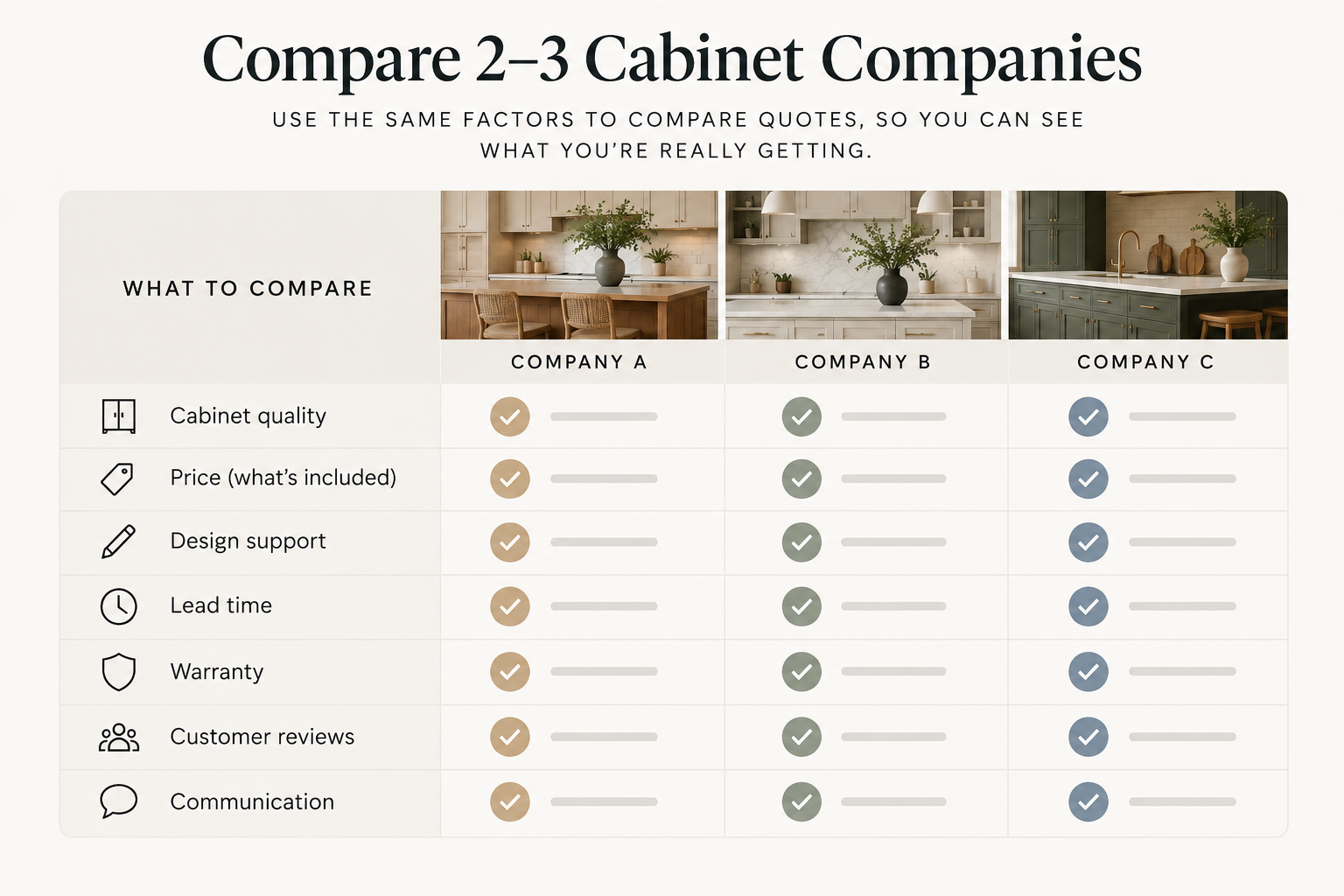
You don’t need to collect ten quotes. In fact, getting too many can make the decision harder.
For most homeowners, two or three serious contenders are enough to create a useful comparison.
Start by eliminating companies that clearly don’t fit your project.
Then take your remaining options and compare these factors for each one.
Use the same questions every time:
| What to compare | What to look for |
| Cabinet quality | Construction, materials, hardware, finish |
| Price | What’s included and what’s extra |
| Design support | How much help is available before ordering |
| Lead time | Expected production and shipping timeline |
| Warranty | Coverage and claims process |
| Reviews | Specific experiences from real customers |
| Communication | How easy it is to get clear answers |
If terms like inset, overlay, framed, frameless, or RTA are still making your eyes glaze over, our guide to common kitchen cabinet terms can get you comfortable with the language before you compare products.
What About Kitchen Cabinet Brand Rankings?
It’s tempting to ask Google or AI what the “best cabinet brands” are and just work your way down.
But kitchen cabinet brand rankings have a limitation: there isn’t one cabinet brand that’s objectively right for every kitchen.
It all depends on what you’re trying to accomplish. If you’re renovating a small starter kitchen on a tight budget, you may have very different priorities from someone building a large, high-end kitchen with custom storage.
Even within the same brand, different product lines can vary in construction, finish options, customization, and price.
So this may be a more useful question to ask:
“Does this cabinet line give me what I need at a price I’m comfortable with, from a company I feel confident working with?”
When You’ve Compared Enough
Once you’ve narrowed your options to two or three companies, compared pricing and construction, read meaningful reviews, and gotten answers to your biggest questions, you probably have enough information to move forward.
That next step could be requesting a quote, ordering samples, or scheduling a design consultation. Research should help you make a decision, not prevent you from making one.
Browse kitchens we’ve completed to see how different cabinet styles look in real homes.
Ready to Take the Next Step?
You don’t need every detail figured out before you reach out.
The iCabinetry team can help you explore your options and find cabinetry that fits your kitchen, style, and budget.
FAQs: Kitchen Cabinet Buying Guide
Look for specific details about the project, ordering process, timeline, communication, and how the company handled any issues. Detailed reviews are more useful than generic five-star ratings because they tell you what the experience was actually like.
For most homeowners, comparing two or three qualified companies is enough. Just make sure you’re comparing similar products and asking each company about the same factors, including construction, lead time, support, and warranty.
A cabinet brand manufactures the cabinetry, while a cabinet company may sell one or several brands and provide services like design, quoting, ordering, and support. iCabinetry Direct is an example of the latter. When comparing companies, consider both the cabinet line and the experience you’ll get from the company selling it.
Rankings can help you discover cabinet brands, but they don’t tell you which one is right for your kitchen. Use them as a starting point, then compare factors like price, construction, style, customization, lead time, and warranty.
Compare construction, materials, finishes, design support, lead time, warranty, delivery costs, and what’s included in the quote. A lower cabinet price isn’t necessarily a lower overall cost if important services or components aren’t included.