You measured, planned, and double-checked everything. Ordering cabinets should be straightforward, right?
But if you’ve ever read remodel stories, you’ve seen how quickly things can go sideways. Cabinets that don’t fit, fridge doors that won’t open fully, drawers that collide at corners. Most of the time, it starts with a small technical oversight that snowballs from there.
Kitchen cabinet mistakes usually happen during measurement, layout planning, or ordering without professional review. The most common errors are incorrect dimensions, appliance spacing problems, missing fillers, and specification misunderstandings.
A structured 3D design review process helps catch these issues before cabinets are ordered, preventing costly reorders and installation delays.
Once cabinets go into production, changes aren’t simple. A half-inch miscalculation or a missed clearance requirement can delay installation for weeks. The key isn’t making ordering more complicated — it’s making mistakes harder to make in the first place.
The Most Common Kitchen Cabinet Mistakes
Most kitchen cabinet mistakes fall into three categories: measurements, layout, and ordering details. None of them are dramatic. All of them are preventable.
- Incorrect Measurements
Measurement errors are the quiet culprits behind the biggest remodel headaches.
Common kitchen cabinet measurement mistakes include:
- Assuming wall heights are perfectly consistent
- Forgetting to account for crown molding or ceiling variance
- Misreading appliance specifications (especially depth and door clearance)
- Ignoring uneven floors
- Measuring drywall without checking stud placement
Cabinets are built to exact dimensions, and they don’t “adjust” on site. If your ceiling dips half an inch on one side of the room, your upper cabinets won’t work around that.
Before submitting specs, review how to measure kitchen cabinets correctly to ensure you’re capturing every dimension that affects installation.
Precision at this stage protects everything downstream.
- Cabinet Layout Mistakes
Layout issues don’t show up in drawings; they show up in the room.
Common cabinet layout mistakes include:
- Tight walkways around islands
- Drawer fronts hitting appliance handles
- Corner cabinet door collisions
- Insufficient landing space near sinks or ranges
A layout that looks balanced in 2D can feel cramped in real life.
Understanding clearance guidelines early makes a difference. Our kitchen cabinet layout guide covers spacing standards that help prevent these functional problems before installation day.
- Ordering Cabinets Online Without Spec Review
Factory-direct ordering gives you access to better pricing and assembled delivery. But it also requires careful spec confirmation.
Mistakes when ordering kitchen cabinets online often include:
- Selecting the wrong cabinet depth
- Assuming soft-close hardware is standard
- Forgetting filler strips at wall ends
- Overlooking trim compatibility
Because factory-direct systems follow structured specifications, understanding the full factory direct kitchen cabinets process helps clarify what needs to be confirmed before production begins.
🛠️ Pro Insight: The most expensive cabinet mistakes are dimensional. A half-inch miscalculation can prevent proper installation and require reordering entire cabinet runs.
Why Online Layout Tools Don’t Catch Issues
Online cabinet layout planners are useful visualization tools, but they’re not validation tools. Why? Because they rely entirely on user input.
They don’t know:
- If your walls bow slightly
- If your ceiling dips in one corner
- If your appliance specs were misread
- If a filler is required for door clearance
They confirm placement, but not real-life performance.
This becomes even more crucial when comparing cabinet tiers.
Semi custom and full custom lines allow different modification options, which is why planning considerations shift depending on what you’re ordering. We cover that nuance in our semi custom vs custom cabinets comparison.
What a Professional 3D Cabinet Review Includes
A structured 3D review process is primarily about verifying cabinet fit and layout.
It typically includes:
- Dimension cross-checking
- Appliance clearance confirmation
- Filler and trim planning
- Crown-to-ceiling alignment review
- Overlay and hardware confirmation
- Installation readiness validation
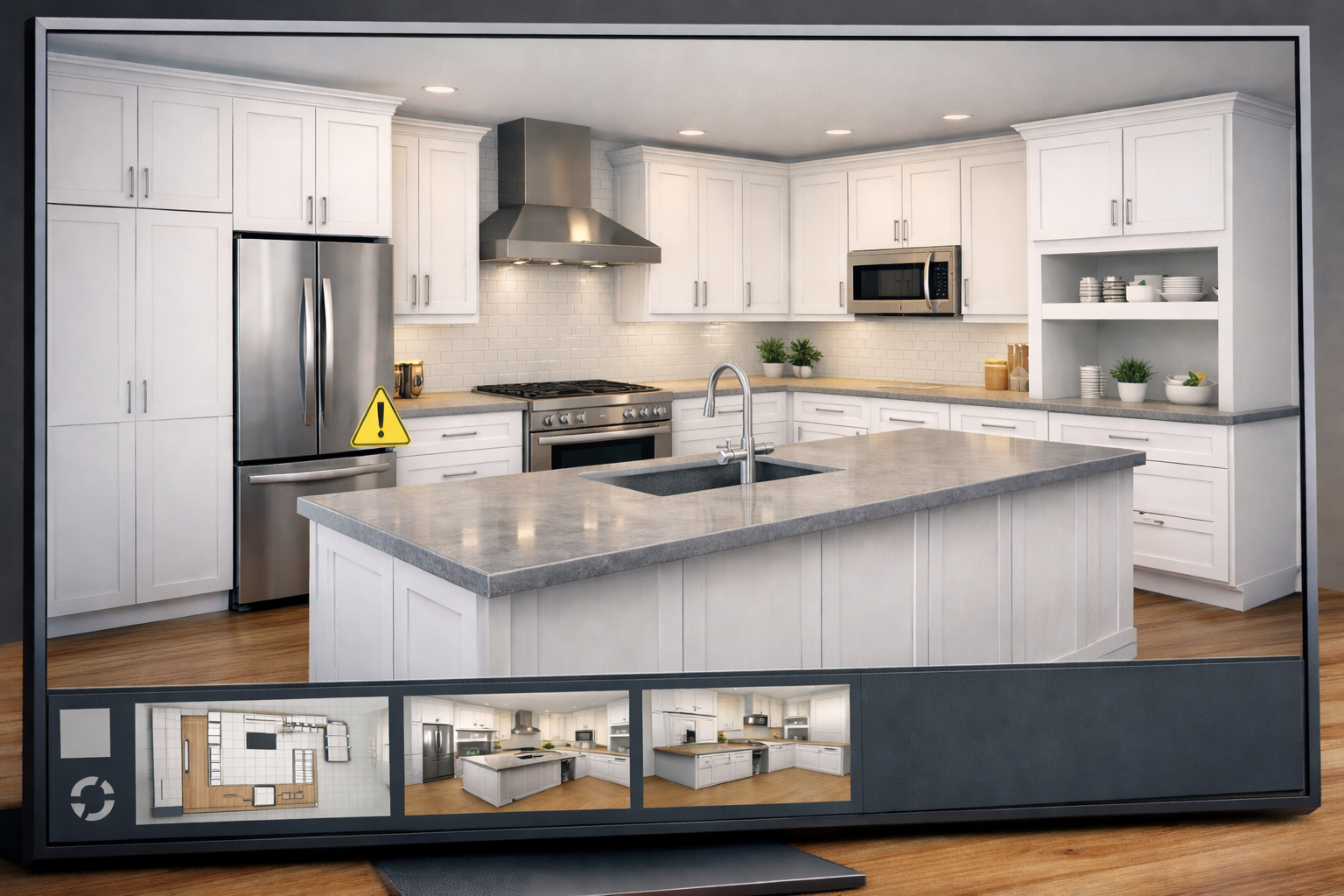
At iCabinetry Direct, this review is integrated into the quote process. Before production begins, you receive a 3D rendering and itemized breakdown for approval.
If you’re ready to see how your layout performs before committing, you can request a free cabinet quote and have those specifications reviewed before manufacturing starts.
🛠️ Pro Insight: The real purpose of a 3D cabinet rendering is collision detection. It helps identify spacing conflicts and specification errors before production begins.
How iCabinetry’s Easy Ordering Process Reduces Risk
Instead of a shopping cart checkout, the process follows a clear path:
- Choose your cabinet line
- Submit layout details and measurements
- Receive an itemized quote and 3D rendering
- Confirm specs before approval
That pause before payment is intentional.
You can browse and shop assembled kitchen cabinets by brand and pricing tier first. But final approval only happens after dimensional review.
It’s not about slowing the process down. It’s about making sure what arrives actually fits.
When DIY Cabinet Ordering Might Be Enough
Some projects are straightforward:
- Replacing cabinets within the same footprint
- Standard ceiling heights
- No appliance changes
- Simple galley layout
If the layout isn’t changing and dimensions are confirmed, a confident DIY buyer can move efficiently. Complexity is what increases risk.
When a Guided Review Process Is the Smarter Choice
Professional validation is especially valuable in these situations:
- You’re adding or relocating an island
- Ceiling heights vary
- You’re selecting semi custom modifications
- Built-in appliances are involved
- Structural changes are part of the remodel
In these cases, dimensional precision protects both timeline and budget.
It also protects long-term coverage. Most manufacturers we offer at iCabinetry include lifetime protection when cabinets are specified and installed correctly.
Mistakes delay installs, but they can also affect warranty eligibility.
What Cabinet Mistakes Actually Cost
The financial impact isn’t always obvious at first. But the consequences include:
- Reordering cabinet runs
- Return freight on assembled units
- Contractor downtime
- Delayed countertop installation
- Additional trim or filler purchases
Production timelines typically run 4–8 weeks. Reorders restart that clock.
That’s why the smallest dimensional errors can have the biggest ripple effects.
Final Thoughts: Cabinets Are Easy to Choose. Harder to Correct.
Choosing a style is the fun part. But it’s not fun (or cheap) to correct a miscalculation.
Kitchen cabinet mistakes usually start small, like a skipped clearance or a misread spec.
By being smart and thorough in the ordering process with partners you trust, you’ll greatly reduce preventable risk.
If you’d like dimensional review built into your purchase process, you can start your cabinet quote and 3D review before finalizing your order.
Because once cabinets go into production, guessing stops being affordable.
FAQ: Common Kitchen Cabinet Mistakes
What are the most common kitchen cabinet mistakes?
Incorrect measurements, poor appliance spacing, inadequate filler planning, and ordering without professional layout validation.
Can I design my own kitchen cabinets online?
Yes, but online tools rely entirely on user accuracy. Professional review reduces the risk of dimensional or specification errors.
Does iCabinetry offer design services?
iCabinetry provides structured 3D rendering and specification review as part of its guided ordering process. A deposit may apply for full design services.
How long does cabinet delivery take?
Most cabinet brands deliver within 4–8 weeks depending on the selected line.