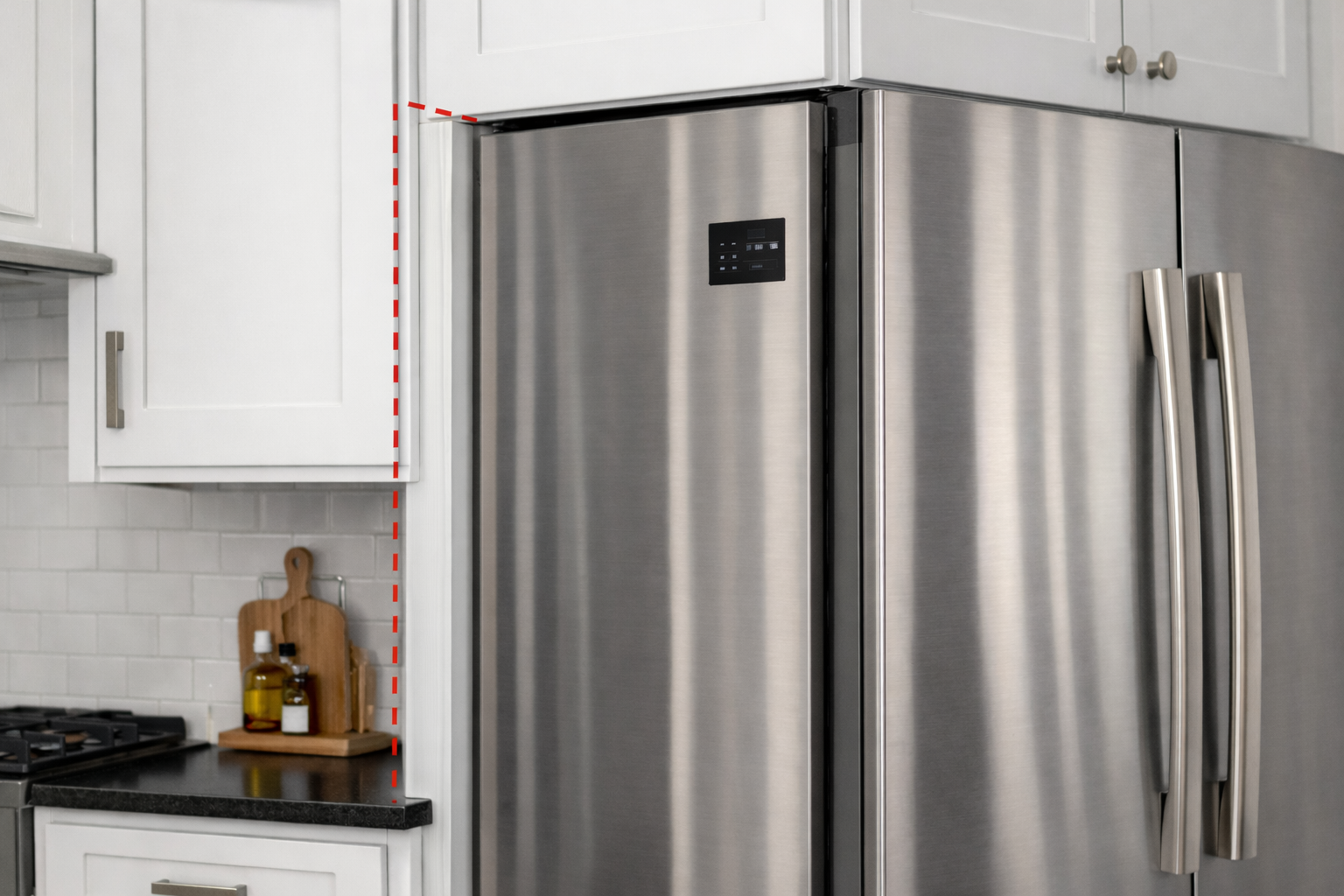
You don’t usually notice cabinet filler panels when they’re installed right. And that’s exactly the point.
But when they’re missing? You’ll definitely notice. A drawer will hit the wall, or a cabinet door won’t fully open. There’s an awkward gap you can’t unsee once you spot it—and just like that, a kitchen that once looked great just feels slightly off—usually because of small kitchen layout decisions that weren’t fully thought through.
Kitchen cabinet filler panels are thin pieces of material used to close gaps between cabinets, walls, and appliances. They’re essential for proper spacing, smooth door and drawer operation, and achieving a clean, built-in look.
This guide covers when you actually need them, where to place them, and how to use them well so your kitchen works and looks seamless.
What Are Kitchen Cabinet Filler Panels?
Kitchen cabinet filler panels are narrow strips of material used to fill space between cabinets and surrounding elements like walls, appliances, or other cabinets.
They’re simple in theory, but surprisingly important in action.
Here’s where they’re typically installed:
- Between a base cabinet and a wall (which often comes down to getting base cabinet depth and spacing right).
- Next to appliances like dishwashers or refrigerators.
- At the end of a cabinet run.
- In corners where doors need clearance.
They might look like trim, but they actually serve a functional purpose.
They help:
- Make sure cabinet doors and drawers open properly
- Account for uneven walls
- Create a flush, aligned installation
- Avoid awkward gaps that break the overall look
Without filler panels, even high-end kitchen cabinets can feel poorly fitted.
When Kitchen Cabinet Filler Panels Are Necessary
Filler panels aren’t “nice-to-have.” In many layouts, they’re what makes the whole design arrangement work.
You’ll almost always need fillers in these situations:
- Tight wall clearances. If a cabinet sits directly against a wall, the door may not open fully. Handles can hit the wall, but drawers can’t extend.
→ A small filler (often 1–3 inches) solves this instantly.
- Uneven walls. It’s common in homes for walls to bow, corners aren’t square, and floors to shift over time.
→ Fillers give installers room to adjust and keep everything aligned.
- Next to appliances. Dishwashers, ranges, and fridges need breathing room.
→ Fillers help with proper spacing, easy installation, and no rubbing or crowding.
- Corner cabinets. Corner setups can get tight and dysfunctional fast, especially if you’ve run into corner cabinet layout challenges before.
→ Fillers prevent doors from colliding, drawers from catching, and dead zones with no usefulness.
- End of cabinet runs. When cabinets don’t land perfectly wall-to-wall.
→ Fillers help “finish” the run so it doesn’t look cut short.
🛠️ Pro Insight: Fillers should be planned during layout, not added after something doesn’t fit. Retrofitting them is always more challenging.
Where to Place Filler Panels for the Best Results
With proper placement, filler panels go from a functional fix to a true design choice.
If they’re done well, they should disappear into the layout.
Here are the most common (and important) placements:
Against walls
- Prevents doors from hitting
- Allows drawers to fully extend
Between cabinets and appliances
- Maintains consistent spacing
- Makes installation smoother
At the end of cabinet runs
- Creates a clean stopping point
- Avoids random gaps
Between cabinet sections
- Helps align doors and drawers
- Keeps spacing symmetrical
Think of fillers as spacing tools, not patches.
They help your kitchen feel balanced and thought-through, instead of pieces squeezed in wherever they fit.
Design Tips for a Seamless Built-In Look
Filler panels are at their best when no one notices them. They’re there to let everything else line up so cleanly that they disappear into the cabinetry.
That starts with matching—your filler panels should use the same color, finish, and material as your cabinets. If they don’t, they’ll read as an add-on instead of part of the design.
And width matters more than people expect. If a filler is too narrow, it can feel accidental. But too wide, and it starts to look bulky, breaking up the visual flow. Most kitchens land somewhere in that subtle middle ground. Just enough space to function, not enough to stand out.
Follow these few simple rules to keep things looking intentional:
- Match the cabinet color, finish, and material
- Keep filler widths consistent and proportional
- Align filler edges with cabinet doors and vertical lines
Alignment is where everything clicks. When filler panels line up with cabinet doors and edges, the entire run feels smooth and continuous.
It also helps to step back and look at the full wall. Kitchens read in long lines, not individual boxes. Sometimes adding a matching filler on the opposite side of a section creates better balance overall.
Common Mistakes to Avoid with Cabinet Filler Panels
Most filler panel issues don’t come from the panels themselves. They come from when (or how) they’re used.
One of the most common mistakes? Skipping them during initial planning.
Everything looks perfect on paper, but once cabinets are installed, a door can’t fully open or a drawer hits the wall. At that point, adding a filler becomes a patch, not a part of the design. And it rarely comes out looking clean.
Another issue is treating fillers like a visual afterthought. If the finish doesn’t match, or the sizing feels inconsistent, they stand out right away and break the flow of the kitchen.
Here are the mistakes that show up most often:
- Skipping fillers entirely → leads to clearance issues and tight spacing.
- Adding them too late → results in awkward, visible fixes.
- Using mismatched finishes → makes fillers stand out instead of blend in.
- Going too wide or too narrow → throws off proportions or function.
And then there’s hardware. Cabinet handles and pulls need space too. Without proper fillers, even a well-placed cabinet becomes frustrating to use.
Most of these mistakes come down to the same thing: trying to make everything fit exactly instead of allowing a little room for adjustment. Filler panels are that room. And when you account for them upfront, everything else tends to fall into place.
FAQs about Kitchen Cabinet Filler Panels
Do all kitchens need cabinet filler panels?
No, but most do. Any layout with walls, corners, or appliances usually requires them for proper spacing and function.
How wide should kitchen cabinet filler panels be?
Typically 1–3 inches. The exact width depends on wall conditions, cabinet placement, and clearance needs.
Can filler panels be added after cabinets are installed?
Yes, but it’s not ideal. They work best when planned upfront as part of the layout.
Should filler panels match cabinet doors exactly?
Yes. Matching color, finish, and material helps them blend in and maintain a cohesive look.
Are cabinet filler panels decorative or functional?
Both, but primarily functional. They ensure proper fit, alignment, and usability, while also supporting a clean, built-in appearance.