If you’re just starting to research kitchen cabinets, you’ve probably run into some unfamiliar terms. RTA. Pre-assembled. Semi-custom. Custom. It’s a lot to digest when you’re remodeling your kitchen, and unfortunately most cabinetry sites assume homeowners already know what these mean. So we’re here to clear the air about RTA and custom cabinets, and how these two compare.
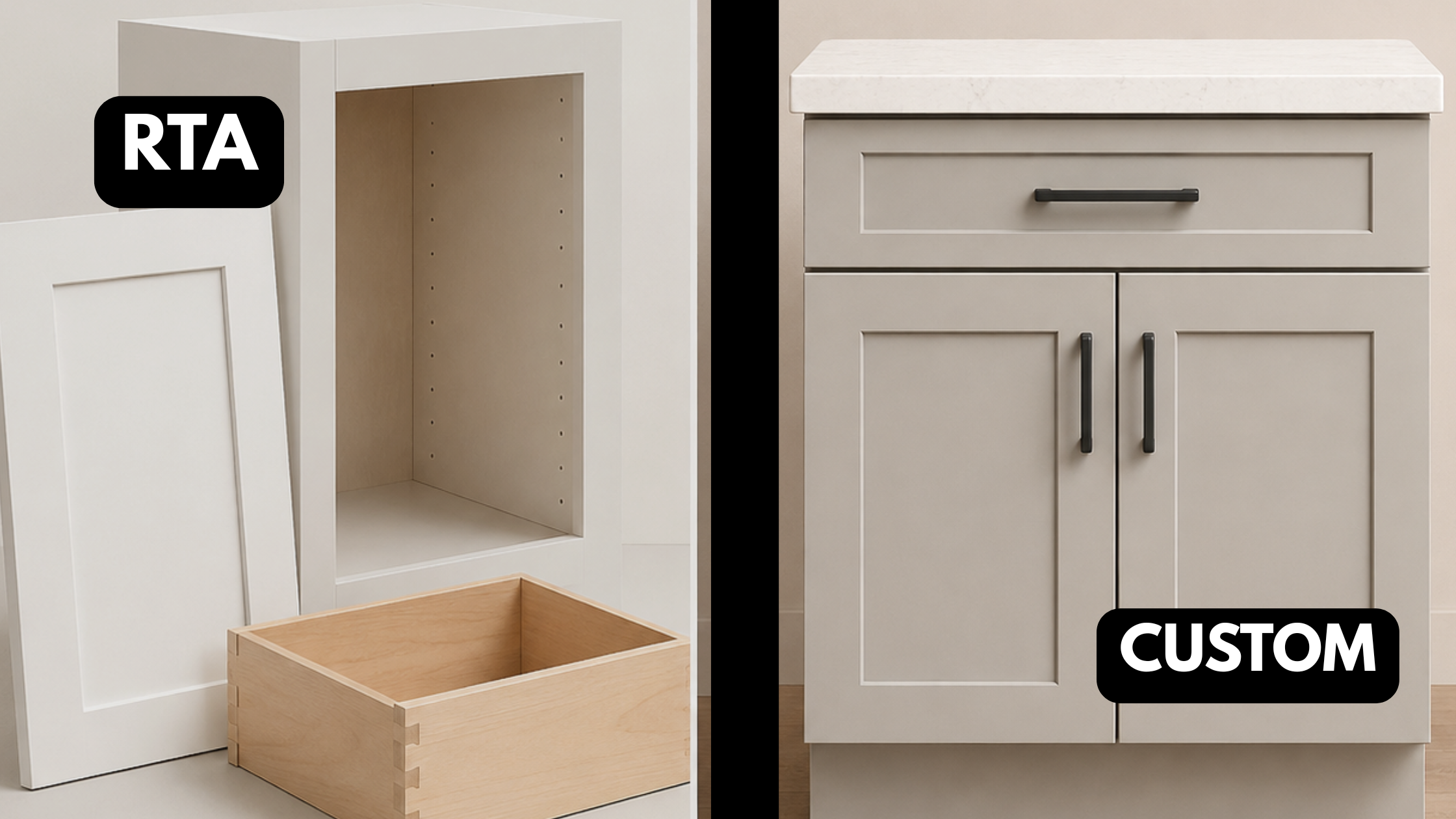
RTA (Ready-to-Assemble) cabinets ship flat-packed for on-site assembly. This makes them a faster, lower-cost option. Custom cabinets are built to order and arrive fully assembled. They offer greater durability and design flexibility, at a higher price point and longer lead time.
The right choice depends on your budget, timeline, and how long you plan to stay in your home.
So, let’s start from the beginning.
What Does RTA Mean?
RTA stands for Ready-to-Assemble. These cabinets ship to you flat-packed, similar to how furniture from a big-box store arrives. You or your contractor put the pieces together on-site using the included hardware.
RTA cabinets typically use one of two assembly methods: cam-lock fasteners (small interlocking clips, no tools needed) or dowel-and-glue construction (sturdier, but requires more skill to assemble correctly).
If you’re comparing RTA options, ask which method a line uses, since it directly affects how forgiving the assembly process is for a first-timer.
What Does Custom Mean?
Custom cabinetry means the cabinets are built specifically for your kitchen, not pulled from a set of standard sizes. You’re not choosing from a handful of pre-set options. You’re choosing from thousands of combinations: wood species, door styles, finishes, hardware, and exact dimensions built to match your space.
Here’s how the process goes. First, you sit down with a designer to work out the details: door style, finish, layout. Then the cabinets get built in a factory, one at a time, to those exact specs. They arrive fully assembled and ready to install. No cam-lock clips, no dowel-and-glue, no assembly step for you or your contractor to get wrong.
That factory process is also why custom takes longer than RTA. Since nothing exists until you order it, expect 6-8 weeks (sometimes more, depending on how customized your order is). RTA, by comparison, is ready almost right away.
🛠️ Pro Insight: Custom and semi-custom aren’t the same thing. Semi-custom gives you more flexibility than stock cabinets, but still within a set range of options. Full custom means the cabinet is built around your exact kitchen, quirks and all.
Considering full cabinet customization? Browse iStyle Custom by Starmark to explore wood species, finishes, and door styles.
Where Does “Pre-Assembled” Fit In?
Here’s where a lot of people get confused, and it’s understandable: “pre-assembled” isn’t the same as either RTA or full custom. It’s its own category.
Pre-assembled cabinets arrive already built, like custom cabinets do. But they’re typically made in standard or semi-custom sizes rather than built to your exact specifications. It’s like a middle step: no assembly required, but less design flexibility than a fully custom order.
If you’ve been searching for “pre-assembled kitchen cabinets,” you’re likely looking for something that skips the DIY labor of RTA, and doesn’t come with the cost and lead time of full custom. That’s a reasonable middle ground, and it might be good to know that option exists.
Quick Reference: RTA vs. Custom
| Feature | RTA Cabinets | Custom Cabinetry |
| Construction | Flat-pack, self-assembled | Precision-engineered, factory-assembled |
| Customization | Limited sizes and finishes | Extensive (10,000+ combinations) |
| Durability | Depends heavily on assembly quality | Consistently high, built for longevity |
| Lead Time | Fast, often available immediately | 6-8 weeks (though may be longer depending on customization level) |
| Expert Support | Typically none included | Professional design support included |
Is RTA actually a bad choice?
Let’s dispel some myths about RTA cabinets. They get a bad reputation they don’t always deserve. Here are a few things to know before you rule them out completely:
Myth: All RTA cabinets are low quality.
Not true. Quality varies greatly by brand and material. Solid wood RTA cabinets exist and can hold up well; the “cheap” reputation usually comes from particleboard options at the lowest price point, not RTA construction itself.
Myth: RTA always looks obviously DIY.
A carefully assembled RTA cabinet, installed by someone who takes their time, can look clean. The gap between RTA and custom is usually more about long-term durability than day-one appearance.
Myth: You need advanced tools to assemble RTA cabinets.
Most RTA lines are designed for basic household tools, a drill and a level go a long way. Cam-lock systems in particular are built for non-professionals.
Choosing RTA Cabinets: A Few Tips
Since RTA is a valid choice for the right project, here’s how to set yourself up for a good experience.
- Choose solid wood or plywood boxes over particleboard if your budget allows. This single decision affects durability more than almost anything else.
- Read the assembly method before you buy. Dowel-and-glue construction is sturdier long-term, but cam-lock is far more forgiving for a first attempt.
- Budget extra time, not just money. A full kitchen’s worth of RTA cabinets can take a full weekend or more to assemble correctly. Rushing is where most mistakes happen.
- Inspect every panel before assembly. RTA shipments occasionally arrive with a damaged or missing piece. Catching it before you start is far easier than catching it halfway through.
When Should You Choose Custom Cabinets?
Custom cabinetry is usually the better fit when:
- You’re designing a forever home, not a short-term or rental space
- Your kitchen has architectural quirks (historic walls, unusual appliance placement) that off-the-shelf sizing can’t accommodate
- You want a specific finish, wood species, or hardware combination that isn’t available in stock lines
- Long-term durability matters more to you than upfront cost
When you choose lines like iStyle Custom Inset by Starmark or iEuro Custom by Ultracraft, you’re paying for factory-controlled precision from the start. There’s no relying on an assembler (professional or otherwise) to make everything align.
🛠️ Pro Insight: Custom cabinets offer stronger long-term ROI. A kitchen with well-fitted custom cabinetry is a real selling point down the road, while lower-tier RTA can show wear within just a few years.
What You’re Paying For with Custom
The price gap between RTA and custom isn’t just markup, it reflects real differences in labor and materials:
- RTA cabinets run lower upfront, but you’re providing the labor yourself (or paying separately for assembly and installation help)
- Custom cabinets from iCabinetry Direct start around $232–$371/lf depending on the line, which includes factory assembly and professional design support
- Installation labor for either option typically adds $50–$200 per linear foot on top of the cabinets themselves
Seeing the real numbers side by side, rather than just “RTA is cheaper,” makes that decision a bit clearer.
How iCabinetry Direct Works
iCabinetry Direct isn’t an RTA brand. We’re a factory-direct distributor connecting you to established manufacturing partners, so you get professional-grade custom cabinetry at wholesale pricing, without a showroom markup.
Ready to Start Your Project?
Whether you’re leaning toward RTA for a quick refresh or interested in exploring full custom, understanding your options is the first step.
If you’re ready to see what custom cabinetry could look like in your home, request a free cabinet quote.
Our team can guide you through finish selection, layout, and everything in between.
FAQs: RTA vs. Custom Cabinets
RTA stands for Ready-to-Assemble. These cabinets ship flat-packed and are assembled on-site by the homeowner or a contractor.
No. Pre-assembled cabinets arrive fully built like custom cabinets do, but they’re typically manufactured in standard or semi-custom sizes rather than built to your exact specifications.
Usually lower upfront, but RTA can cost more long-term if cabinets need replacing sooner or a professional has to fix assembly mistakes. Custom cabinetry often offers better long-term value.
With our iEuro Custom line, you get access to 10,000+ combinations of styles, finishes, and storage configurations, well beyond what stock or RTA options offer.
Custom cabinets are precision-manufactured, which actually makes them easier for a skilled professional to install than inconsistently sized budget cabinets. We recommend a pro for final installation either way.